

The Next Movement
By: Naomi Patterson
Choosing to pursue an education in another country is a feat in itself. But going the extra mile, pursing a career in that country is a different story; a story familiar to UA doctoral graduate Yongtong Tan.
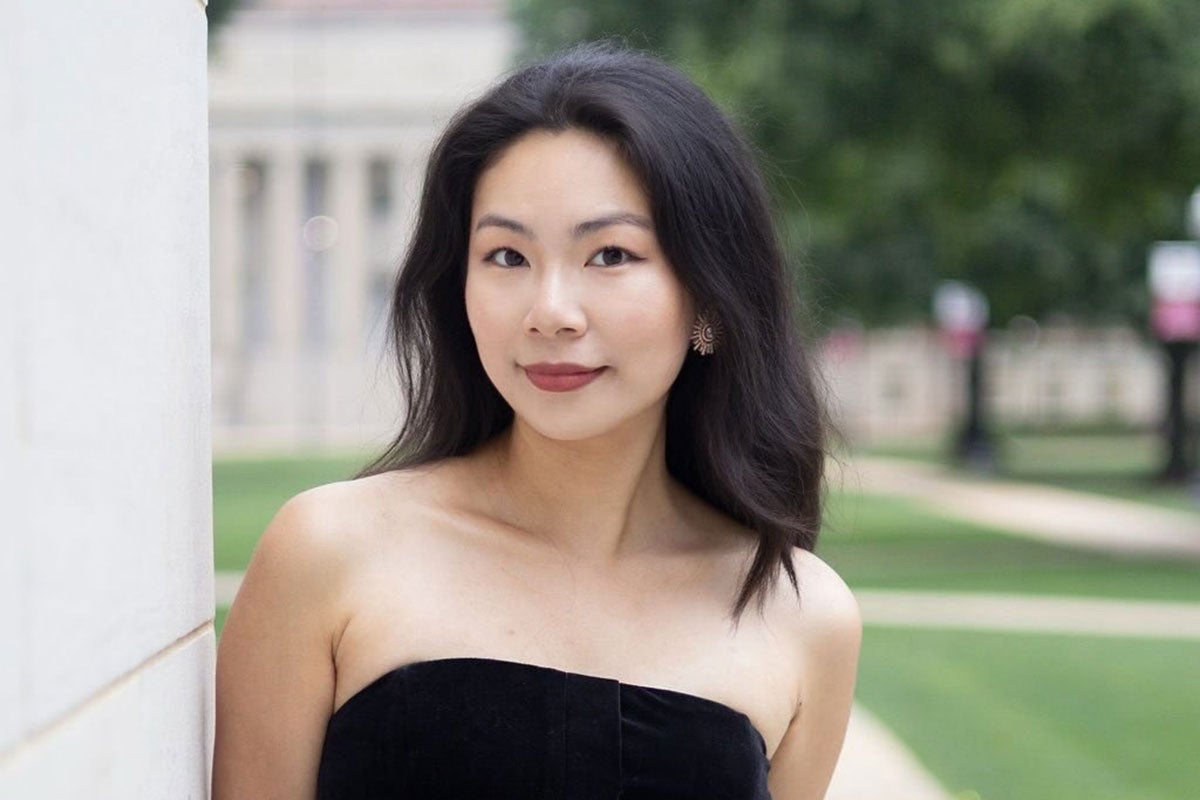
Dr. Yongtong Tan ’26 is from southern China, in the city of Guangdong. She got her start with piano at the age of four, after her mother wanted her to get involved in a craft that would aid in her memory and retention.
“You gain confidence, and you gain security from everything you do, every success that you had, then you speak up, because you know what you can do, and you know better than anyone who you are as a person, and as a musician.”
“My mom wanted me to memorize things a little bit better, and she thought that learning music could train memorization, she said. “So that’s why she started to ask me to go to piano lessons.”
Tan did not start truly pursuing piano until she was 15. After high school, her mother recommended that she look into studying abroad to further pursue her musical career. She applied to several universities in Ohio, before choosing Bowling Green State, where she received her bachelor’s and master ’s degrees.
“I spent seven years there, and I was super lucky,” Tan said. “I met the most amazing teacher I have ever had, and that’s why I started my professional musician life at 18.”
Tan also discussed her transition from China, to becoming an international student in the United States while pursing multiple degrees.
“I was so excited, but one of the things that I needed to get used to was feeling less insecure as a minority,” she said. “I’ve had experiences where there’s only one Asian in the class, and the others are not my race. It makes you scared, especially when you were living in the place where all the people are your race, and then suddenly you are the only one.”
But Tan did not let this insecurity have the final bow. She went on to explain how this insecurity was the very fuel that she needed to continue chasing her dreams.
“That was something that gave me insecurity for years, but that’s what makes music magical,” she said. “You gain confidence, and you gain security from everything you do, every success that you had, then you speak up, because you know what you can do, and you know better than anyone who you are as a person, and as a musician.”
However, this was not the only trial that Tan faced. She also discussed obstacles that she encountered on the road to becoming the musician she is today.
“One of the obstacles that I and other musicians have is that you don’t think you’re good enough,” she said.
Tan discussed how this mindset was emphasized when she was auditioning for festivals during her time at Bowling Green State. Festivals are essentially summer academies or training programs in which classical musicians from universities all over the world are selected to hone their skills in their instruments. Spots for these festivals are limited, which means that musicians were to be graded and ranked based on their audition performance.
“I want to try-out the best,” Tan said about her auditioning for the festivals. She also mentioned reactions to not making it into festivals, and how that turns into a competitive mindset.
“Suddenly you realize that you didn’t get in and then you start to question why,” Tan said. And then you start to say, ‘It seems like it’s not enough, so I’m going to practice harder. I’m going to think harder.’ And then things started to get even more competitive.”
Tan also mentioned how despite this obstacle, these festivals allowed her to learn from other musicians from other universities and improve her skills.
“For classical musicians, our field is very competitive, and everyone wants to be best and pursue excellence because opportunities are so little,” she said. “So that is what I learned during my summer academy. I just kept learning.”
Tan also experienced a period of burnout being a critical obstacle during her time at UA as she pursued her doctorate degree.
“I haven’t stopped playing for 10 years, and I realized that I simply lost the spark,” she said. “I ’m always grateful for all the opportunities and all the competitions that I won, but sometimes, you reach a point that you feel like you ’re just doing it, but you lose the purpose.”
Despite the obstacles, Tan always turns back to music to counter the setback.
“Every time I have [burnout], and then I perform again, I realize, it’s great,” she said. “Especially when you’ve found an audience that appreciate your talent.”
When asked about her initial plans for careers with her music, Tan stated that becoming a professional musician was never on her radar.
“I just wanted to be a faculty member,” she said. “That’s it.”
Tan tied in her upbringing in China with her choice of career as well.
“I think it’s also related to whatever education that we had back in Asia because in Asian countries, our definition of success is that you have a decent job making decent money,” she said. “And back then, you know, piano faculty member teaching in the university? That sounds awesome. Because my teacher had a great life based on that, then I just want to have a great life.”
Despite wanting to be a professor, Tan pursued her musical endeavors and eventually realized that she was good at what she did, which led her to more opportunities.
“When I was 23, I realized that I was actually quite good. When you have so many things done and get your foundation, you realize you have a bigger ability,” she said. “Then, I started to want the competition, and I started to compete.”
After arriving to UA on an assistantship, she felt as though receiving the award truly validated her passion and craft in piano.
“I’m always so grateful to have an institution that appreciates my ability, and sees my potential,” she said. “It confirms that my talent is worth something, and I think there’s no way that I could turn that down.”
Tan then went on to discussed how UA presented her with opportunities to compete and improve her musical skills.
“When I came to UA, I had the chance to do a lot of collaborations with singers and instrumentalists,” she said. “I have been always doing that, but especially here, I have to play opera.”
She discussed how playing opera with the UA music department was new for her, and how it broadened her skills, and the spectrum of what music she was used to playing.
“This is a new genre; it’s not only singers, but you ’re in charge of the music for the whole show,” she said. “Sometimes it’s an hour long, sometimes it’s three hours long, so it keeps you concentrated, and you practice a lot of different ways.”
Tan discussed how the burnout of pursing her doctorate degree led her to cease practicing piano for a few months, where she worked at a music camp. During this time, she began to realize just what she wanted to do once she graduated.
“I stopped practicing for a month or two, and then when I had my summer job, I realized that I wasn’t sure what do I wanted to do,” she said. “At my summer job in camp, I realized that I really want a job that is like teaching and playing at the same time.”
Tan then described the impact of teaching for her students, and for herself.
“I realized that teaching the younger generation is like a reflection of myself, telling myself what I want to do if I ’m learning this,” she said. “It actually reminds me of how to practice more efficiently and being a better pianist, but also performance.”
After discussing her journey to become a professional pianist, Tan then hinted at her future endeavors.
“I will be doing group piano lessons, and then also teaching private lessons, so I ’m very excited,” she said. “I think that it will be a great balance for me to grow as an educator and keep growing as a performer because I don’t want to abandon the identity of playing for people. It’s just a genuine joyful thing to do, no matter what.”
Tan then ended with a few thoughts and encouragement to her younger, 18-year-old self who had just decided to take a big step in her musical journey.
“You will get there. She’s just so happy for me right now that we didn’t give up. We keep going, we stay doing the work that we need to do,” she said. “It also showed me that every step is important, and every step is necessary in my career.”